CREATOR BUSINESS / NEWS ANALYSIS
The $46 Billion Nobody Greenlit
KPMG puts user-generated content spending at $46 billion. Revenue sharing helped build that market. Now some of its stars are landing studio-style deals.
Nov. 11, 2026 · 4-minute read
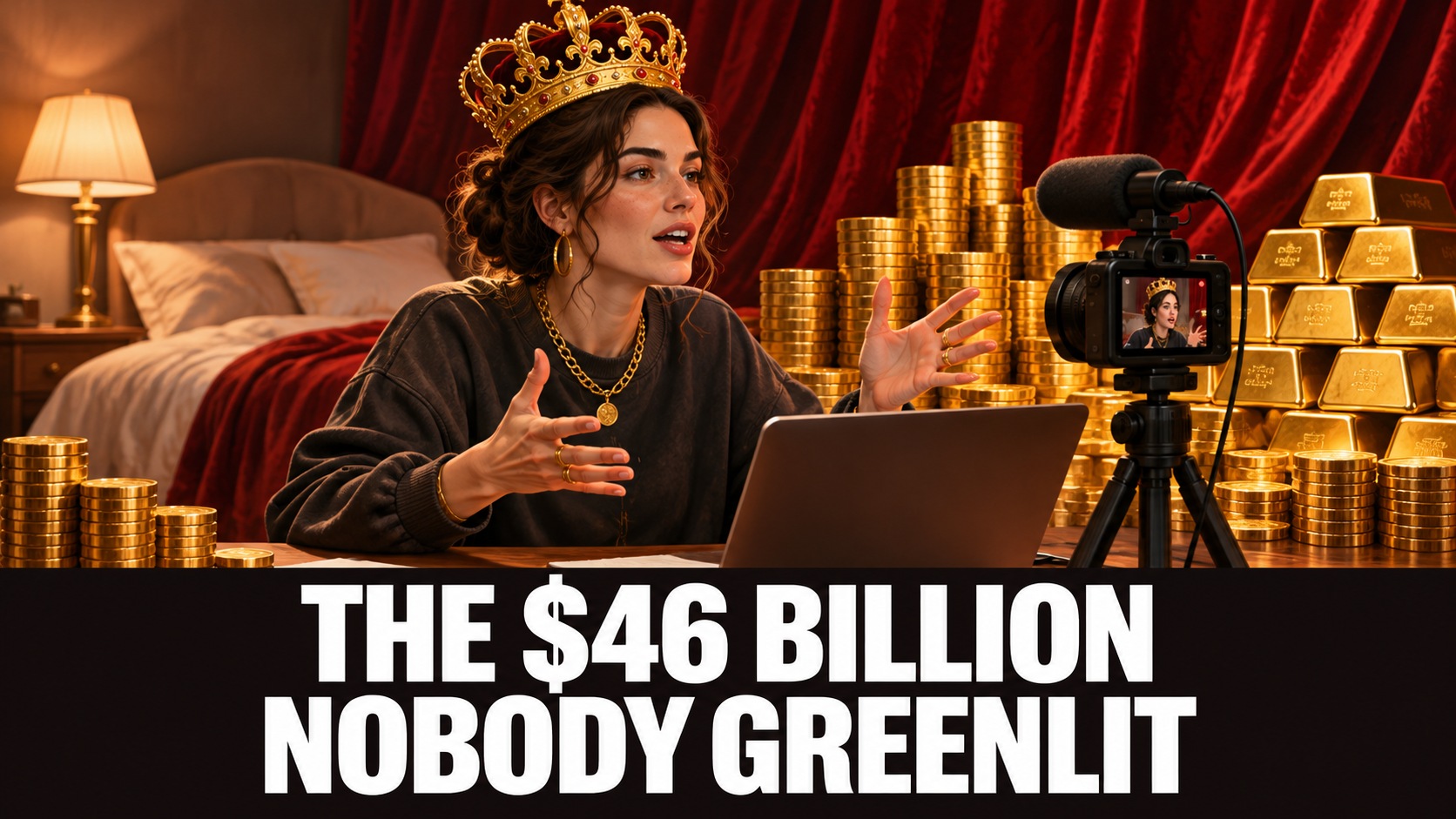 Image: The Bedroom Empire. AI Illustration.
The creator economy has a budget big enough to rival Hollywood. It did not need Hollywood’s permission to build it.
KPMG estimates that user-generated content spending reached about $46 billion in 2025, up 75% from 2021. That represents approximately 22% of the $207 billion spent by the 13 media and platform companies in its analysis.
For creators, the distinction is how that money arrives. A traditional commission can fund production before a show reaches viewers. Under an advertising revenue-sharing model, a creator can pay for the work first and earn a share of advertising revenue after people watch. The platform’s content spending is not automatically the creator’s production budget.
Your channel. Your risk.
YouTube’s published terms illustrate the difference. Eligible partners receive 55% of net revenue from ads on their public watch-page videos. Shorts uses a different calculation: creators receive 45% of the revenue allocated to them from the Creator Pool. Neither percentage guarantees a particular income or reimburses production costs.
That does not mean every dollar in KPMG’s category follows the same arrangement. The report does not quantify how much of the $46 billion was guaranteed or committed in advance. “Nobody greenlit” describes the independent, audience-first route that helped build the market; it is not a claim that every creator production was self-financed.
A bigger pool is not a bigger paycheck
KPMG’s figure is a spending estimate for the companies it tracks, not a measure of independent creators’ take-home earnings. Production expenses, staff, representation and taxes still matter.
Nor is YouTube’s estimated $28 billion in total content spending all independent-creator money. KPMG describes a platform model spanning creator content, subscriptions, music and sports; its film, TV and streaming category includes a proportion of YouTube’s spending.
YouTube separately says it paid more than $8 billion to the music industry between July 2024 and June 2025. That is a different measure and reporting period. It should not simply be subtracted from KPMG’s $46 billion category.
The bedroom empire gets a studio deal
The audience-first model is now meeting the commissioning business. Netflix announced a scripted series with Alan Chikin Chow and HYBE AMERICA in January. In February it announced a partnership with Salish and Jordan Matter covering original projects, consumer products, experiences and their existing archive.
YouTube is also promoting exclusive creator shows. Its May Brandcast announcements included new and returning projects from creators including Kareem Rahma, Quen Blackwell and Trevor Noah. Those announcements establish an exclusive slate; they do not disclose what every creator was paid or who financed each production.
The models are converging. Some creators still fund a channel and earn against its performance. Others negotiate licenses, commissioned series or broader partnerships around an audience they already built.
What to watch in your next deal
A large industry total does not settle the terms of an individual contract. The useful questions are concrete: What payment is guaranteed? Who pays production costs? Who owns the work? Where can it run? What happens to sponsors and clips?
The kingdom may start at a bedroom desk. Keeping it means understanding the difference between audience, revenue and ownership.
← Back to Creator Dispatch